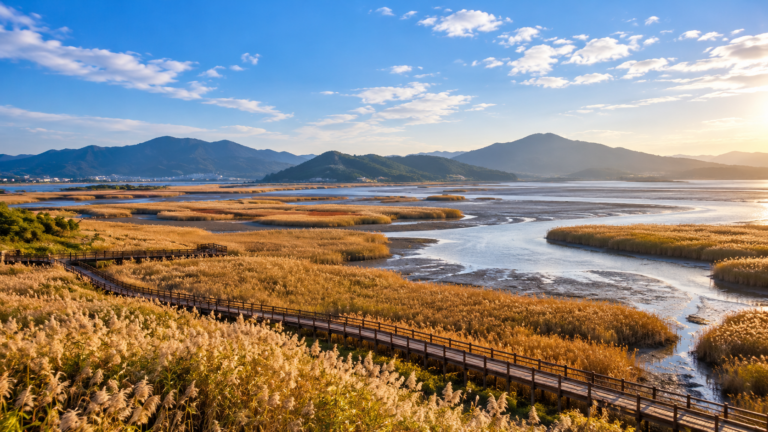

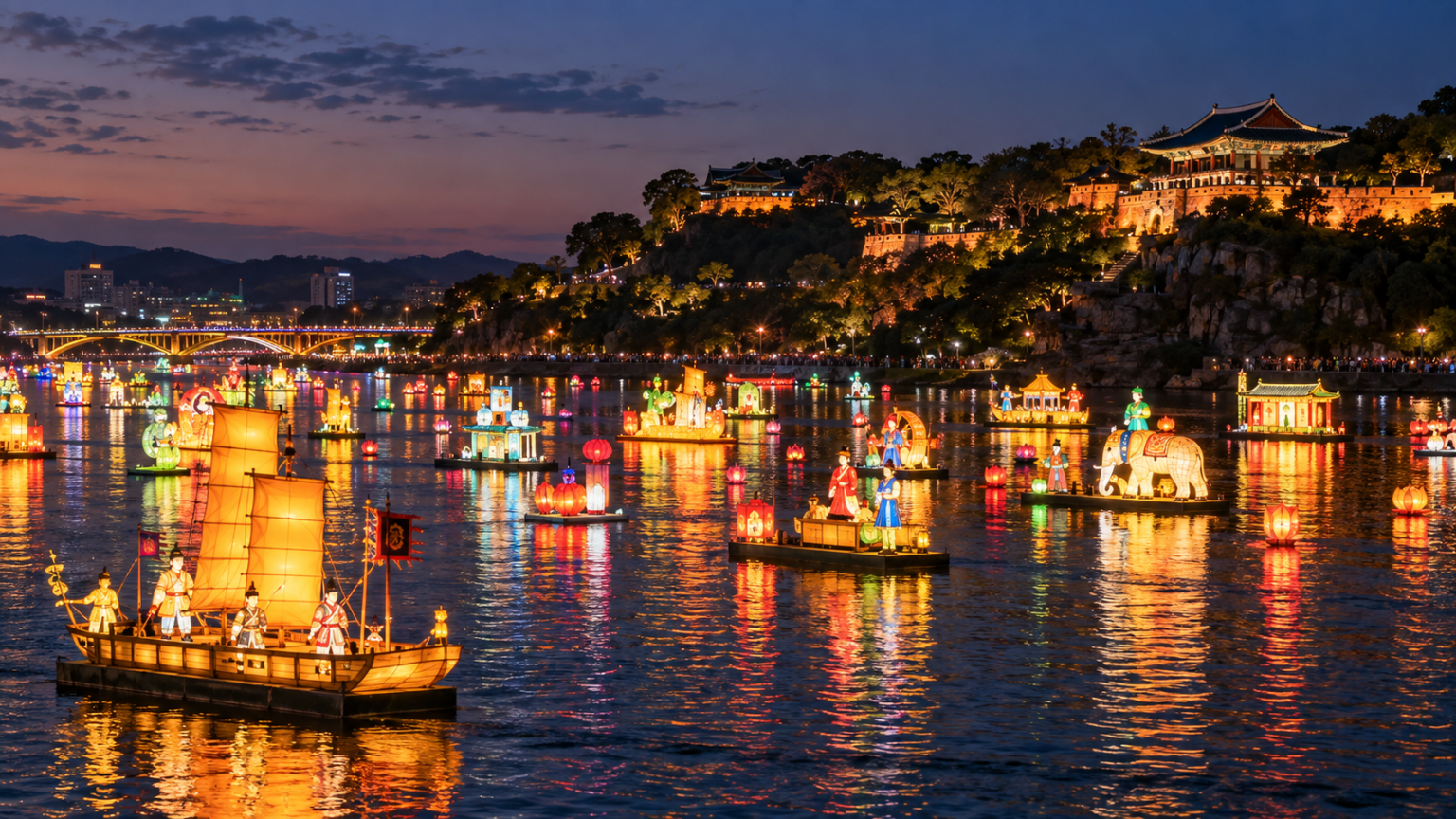
First: is Jinju worth an overnight stay?
For this festival, yes. I would not treat Jinju as a quick evening stop.
There are Korea festivals where you can arrive, walk around for an hour, take a few photos and move on. The Jinju Namgang Yudeung Festival is different because the experience has a clear before-and-after. In daylight you have Jinjuseong Fortress, Chokseongnu, the old center and the market. Then, around sunset, the river becomes the stage.
The 2026 festival runs from October 3 to October 18. Lantern lighting is scheduled for 18:00–24:00, while bridges and festival booths operate from 13:00–23:00. The official venue is Jinjuseong Fortress and the Namgang River area.
If you arrive at 8 PM because “it is a night festival,” you miss part of what makes the trip work. I would rather reach central Jinju with enough time for lunch, walk the fortress in normal daylight, take a break, then return to the river before sunset and watch the same landscape change.

Getting to Jinju without overcomplicating it
If you are coming from Seoul, rail is the first option I would check. Direct services and connections vary by departure time, so I would not build the day around a guessed schedule. Check the actual train inventory for your travel date, then decide whether the timing still gives you a comfortable afternoon in Jinju.
If the train times do not work, intercity and express buses are the obvious backup. The important part is not whether you use train or bus; it is arriving early enough that your first experience of Jinju is not a rushed taxi ride straight into the nighttime crowd.
Compare point-to-point rail tickets first. If your Korea trip includes several long rail legs, then compare a KORAIL Pass rather than assuming the pass is automatically cheaper.
Check Korea rail tickets →Use the route hub for the bigger trip, especially if Jinju is only one stop between Seoul and the south coast.
Open JAY Routes →Day 1: let the city build toward the festival
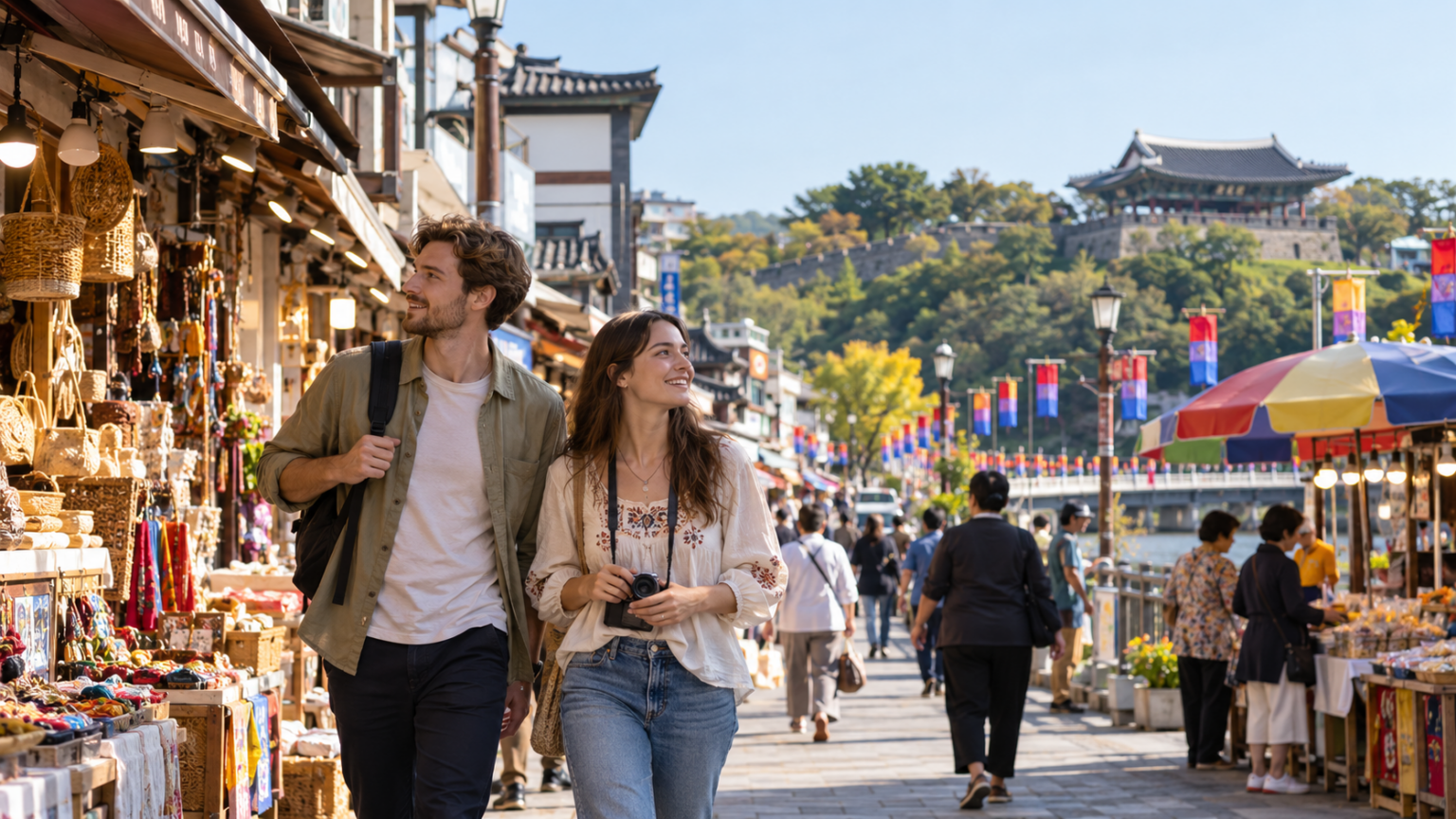
Get into central Jinju before late afternoon
Drop your bag first if you can. On a festival trip, a hotel that saves you a late-night transfer is more valuable than one that is five minutes closer to the station. Once the riverfront becomes crowded, every unnecessary move feels longer.
Eat a Jinju dish before you eat festival food
My first choice would be Jinju bibimbap if you want something specific to the city. It is traditionally associated with a colorful chilbohwaban presentation and is often served with yukhoe. If cold noodles sound better, Jinju naengmyeon with yukjeon is the other obvious local combination.
Festival stalls are great later, but I would use them for snacks, drinks and a second round rather than making them your only meal in Jinju.
Jungang Market → Jinjuseong → Chokseongnu
This sequence gives you three versions of Jinju without wasting time zigzagging across the city. The market shows you everyday Jinju. Jinjuseong gives the historical context. Chokseongnu gives you the river view that will look completely different after the lanterns come on.
Stop sightseeing and position yourself for the night
This is the part people tend to over-plan. You do not need another attraction at 5 PM. Get coffee, rest your feet, charge your phone, and be back near the fortress and river while there is still light in the sky.
The 2026 night schedule that actually changes your date choice
Lanterns are the nightly constant. Drone and fireworks shows are not. If one of those special-event nights matters to you, choose your date deliberately instead of discovering the schedule after your hotel is booked.
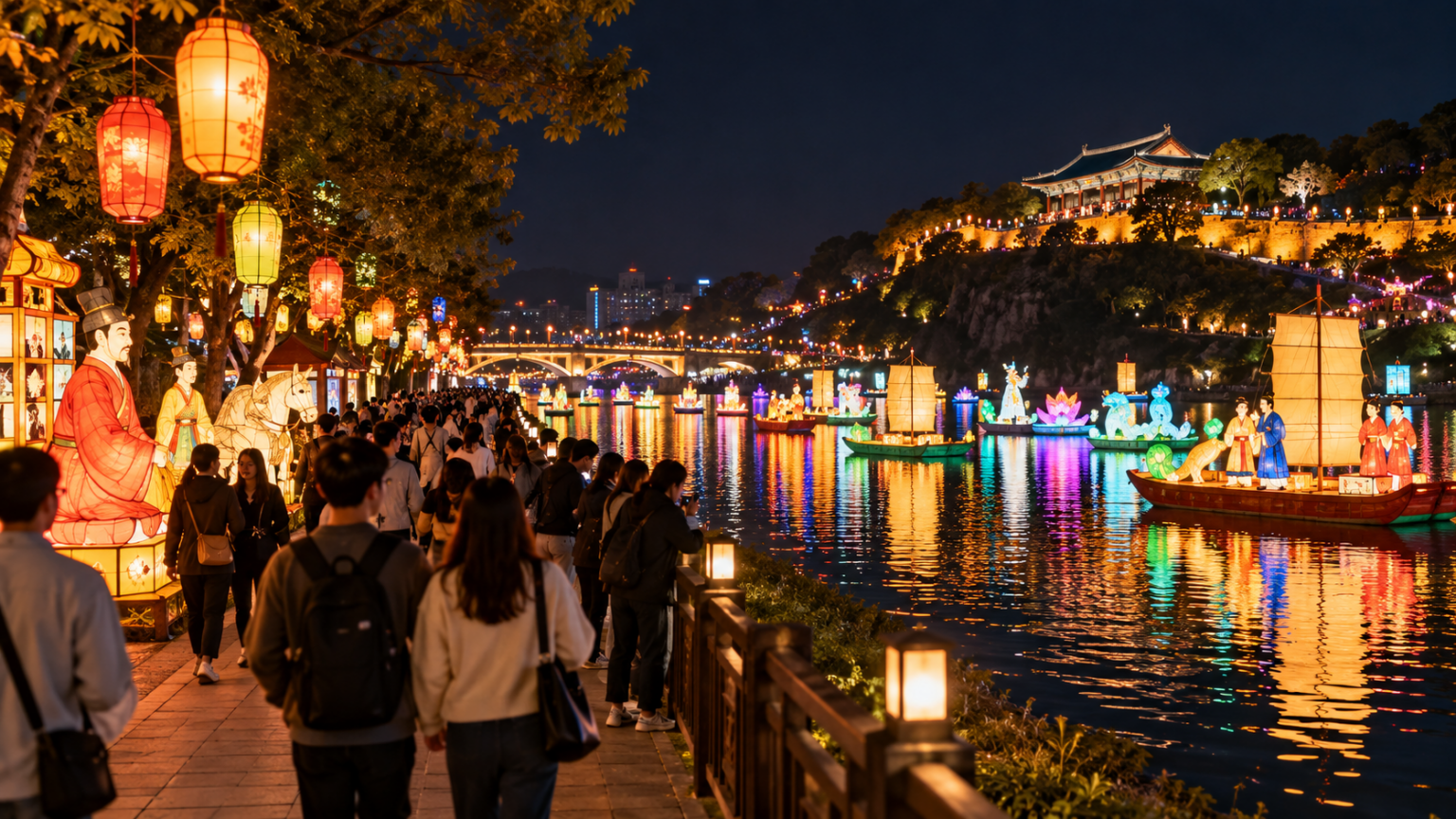
If you want the biggest production, these dates are obvious. If you care more about photography, slower walking and less shoulder-to-shoulder crowding, a normal weekday can actually be the better festival night.
Driving to the festival? This is where plans go wrong
The official festival guidance is unusually clear: avoid driving into the central festival zone if you can. For 2026, Jinju is operating 58 marked city-bus routes with 169 buses, seven free shuttle routes using 80 chartered buses, and 36 temporary parking lots with 11,360 spaces. There is also a Hamo Call festival loop around the venue, operating roughly every 20 minutes with five stops.
If you are entering Jinju by car from outside the city, the smarter strategy is to use a temporary lot near the national-road or IC approaches and transfer to a festival shuttle. Trying to park as close as possible to Jinjuseong sounds convenient until you meet road restrictions, pedestrians and the same queue everyone else has chosen.
What to eat in Jinju
Jinju has enough food identity that a festival guide feels incomplete if it only talks about night-market stalls. I would build at least one proper local meal into the trip.

Jinju bibimbap
The obvious first meal if you want a dish strongly associated with the city. The local style is often connected with yukhoe and the traditional chilbohwaban presentation.
Jinju naengmyeon + yukjeon
A particularly good choice when the afternoon is still warm and you know you will be walking for hours after sunset.
Grilled eel
Another Jinju food that appears in the festival’s own tourism information. Better as a proper dinner than something squeezed between lantern stops.
Jungang Market
Go for the city atmosphere, snacks and a sense of normal Jinju beyond the temporary festival booths.
Where to stay: central Jinju beats “near the station” for this trip
For a normal business trip, station convenience can be a perfectly sensible priority. For the Yudeung Festival, I would flip that logic. Your highest-friction moment is not arrival; it is the end of the night when thousands of people are leaving the riverfront.
I would look first around Jinjuseong, Namgang and the Jungang Market side of central Jinju. If your hotel lets you walk back after the lanterns, you remove one more taxi queue, bus decision or late-night transfer from the trip.
Jinjuseong / Namgang area
This is the location I would prioritize for a one-night festival trip. Use JAY Stay Finder for the broader Korea stay logic, or open the checked Jinju hotel search directly.
Day 2: use the morning for the part of Jinju the lights can hide
Do not automatically check out and run back to Seoul. The morning is when Jinju stops being a festival backdrop and becomes a city again.
After Jinju: don’t automatically backtrack to Seoul
This is where I would make the trip more efficient. If Jinju has already pulled you into the south of Korea, use that geography instead of returning north simply because Seoul was your starting point.
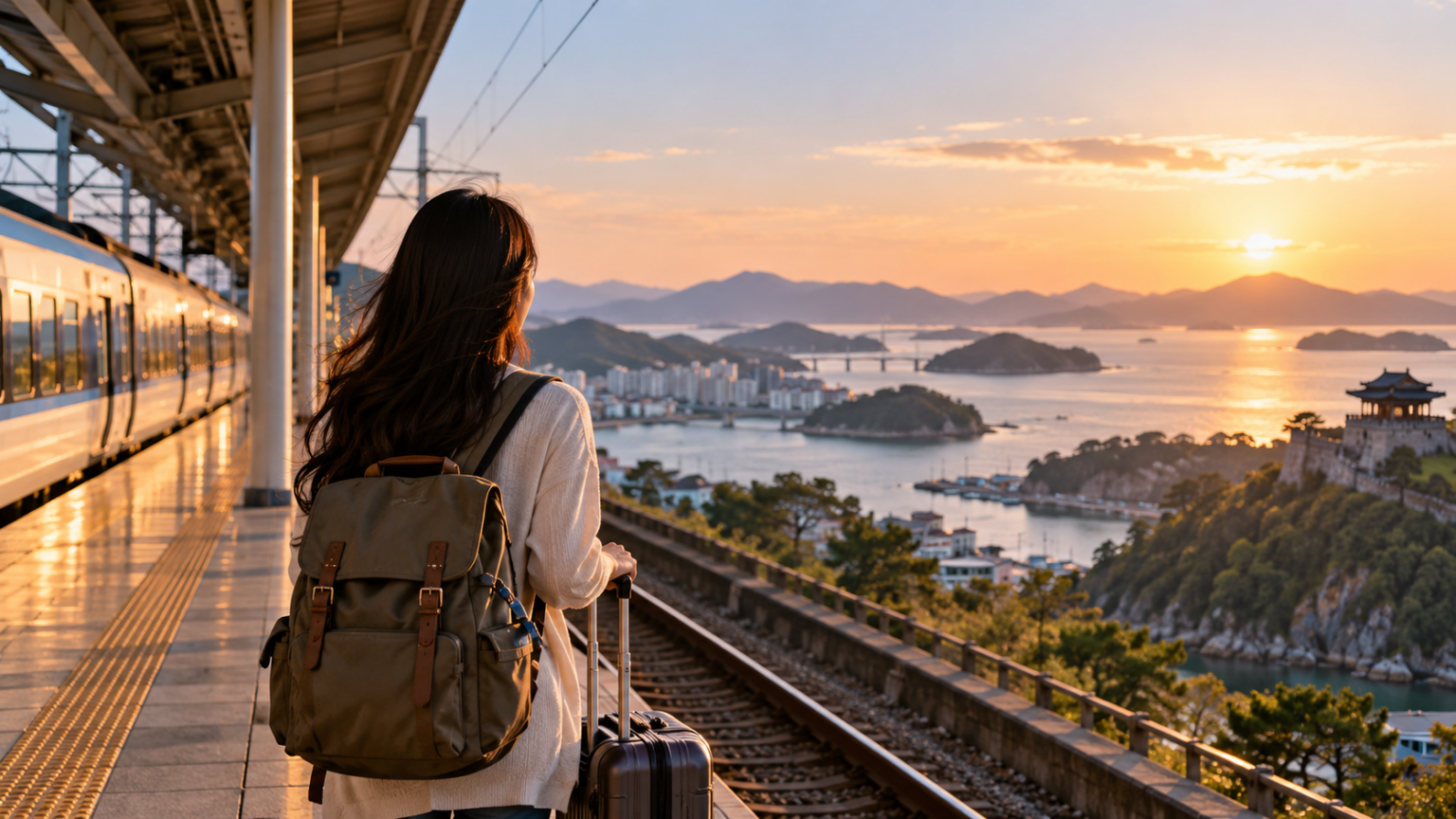
Busan
If you have only one extra night, Busan is the practical continuation: more transport choices, a completely different city scale and an easy way to finish the trip without backtracking.
Tongyeong
Choose Tongyeong if you want sea views, seafood and a slower coastal mood. It works especially well if Jinju was your deliberate break from the big-city route.
Gyeongju
If your Korea trip is history-heavy, Jinju and Gyeongju work for different reasons: fortress and Imjin War context in Jinju, much older Silla history in Gyeongju.
If I had only one extra night, I’d go to Busan. If I wanted a slower coast trip, I’d go to Tongyeong. If this were my first serious Korea history trip, I’d work Gyeongju into the route. What I would not do is automatically return to Seoul just because that’s where the trip started.
The version I would actually book
FAQ for foreign travelers
Jinju works best as part of a route, not as an isolated checkbox.
Use JAY’s tools to decide where to stay, what city comes next and how to fit the festival into the rest of Korea without backtracking.